Tankless vs. Tank Water Heaters: Cost & Energy Savings in Southern California
DOE's numbers say tankless cuts gas use by about a third against old storage units. Here is what the switch really costs in Diamond Bar and when it pays back.
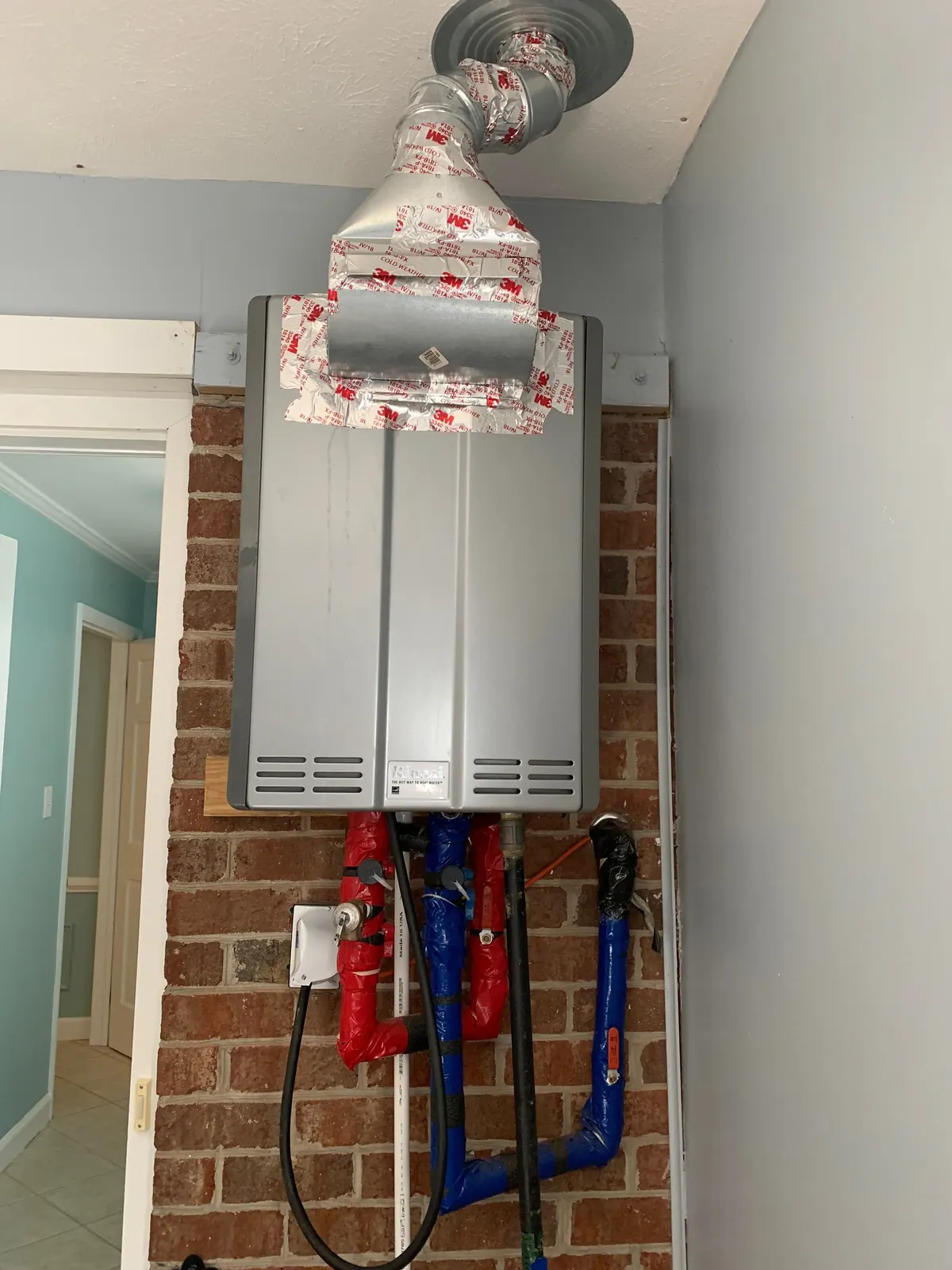
The question behind the question
Most homeowners asking about tankless are really asking two things: will it save money, and will it stop the cold-shower problem. The honest answer to both starts with how the two technologies work, because the differences are structural rather than stylistic.
How they work, and why it matters
A storage tank keeps forty to fifty gallons hot around the clock, reheating as heat leaks away into your garage whether anyone uses hot water or not. A tankless unit fires only when a fixture calls for hot water, heating on the fly as it flows. The U.S. Department of Energy's Building America analysis puts numbers on that design difference: a typical tankless unit's energy factor of 0.8 suggests roughly a 33% reduction in gas use compared with a typical 0.6 energy factor storage model (DOE Building America). ENERGY STAR frames the same idea for consumers: certified gas tankless models cut water heating expenses by heating water only when it is needed (ENERGY STAR).
Real-world savings land below the lab number in high-demand households, where long showers make a tankless unit fire nearly continuously, and closer to it in moderate-demand homes where standby loss dominates. That demand sensitivity is the single most important fact in the decision, and it is why a real survey beats a chart every time.
| Factor | Tank (storage) | Tankless (on-demand) |
|---|---|---|
| Typical installed range* | $1,800-$3,800 | $3,500-$6,500 |
| Hot water supply | Finite tank volume, recovery time | Continuous while firing, sized by flow |
| Standby energy loss | Constant, 24/7 | Essentially none between uses |
| Floor footprint | Full tank footprint | Wall-mounted, reclaims the floor |
| Gas infrastructure | Existing tank sizing usually works | Often needs upsized supply line and venting |
| Maintenance | Annual flush | Annual descaling, critical in hard water |
| Service life | Years, sediment-dependent | Typically outlasts tanks with maintenance |
*Internal 2025-2026 install records for our Diamond Bar service area, including standard gas work. Every project is quoted flat after a free in-home survey.
Where the money actually goes
The purchase price is only half the tankless math; the gas line is the other half. Tankless units fire hard, drawing far more gas during operation than the tank they replace, so many Diamond Bar homes need the supply run enlarged and venting rerouted before the wall unit performs to rating. Quotes that skip the gas work are not cheaper; they are unfinished. Our conversions include the sizing math in the flat quote, which is why our installed range runs where it does.
On the savings side, the federal energy efficient home improvement credit returns 30% of project cost up to $600 on qualifying ENERGY STAR certified gas water heaters (ENERGY STAR tax credit), which pulls the effective premium down for qualifying installs. Add the monthly gas savings and the longer service life, and the payback conversation for a moderate-demand household usually lands within the ownership window of the equipment itself.
Our honest recommendation logic
Choose tankless when your household runs moderate hot water demand, you plan to stay put for years, your garage wants its floor space back, and you will actually keep the annual descaling appointment. Stay with a tank when your household fires multiple long showers simultaneously every morning, when the budget is immediate rather than long-horizon, or when the existing tank is recent and healthy; a like-for-like swap is a perfectly sound answer. Either way, the water here makes annual flushing the difference between equipment that reaches its rating and equipment that dies young. Our water heater service page handles both paths, and the free survey ends with a written recommendation you can take or leave.
The gas math most comparisons skip
Tankless conversations that skip the gas train are selling the sizzle without the kitchen. A tankless burner fires harder than any residential tank, which means the meter, the supply run, and sometimes the regulator all get auditioned before the unit is chosen. Plenty of local homes were plumbed in an era when a fifty-gallon tank was the biggest gas appliance in the garage, and their original line sizes reflect that assumption. The upgrade is routine work, but it is real work with real cost, and it belongs inside the quoted number rather than after it.
Tanks live on the other side of the same coin: their gas demands are modest, which is exactly why a like-for-like tank swap is a half-day project while a conversion runs longer. Neither is better; they are different scopes, and the honest quote says which one your house is buying. When a conversion quote arrives suspiciously cheaper than the survey suggests, the missing line item is usually the gas work, and it resurfaces as a change order with the unit already on the wall.
Maintenance: the tiebreaker nobody weighs
Comparisons love efficiency numbers and ignore the ten-year maintenance story, which is where the real difference often lands. A storage tank asks for an annual flush and an anode check; a tankless unit asks for an annual descale in hard-water regions like ours, plus occasional filter and sensor attention. Neither chore is difficult, and both are non-optional here, because the mineral load in our imported supply punishes neglect on either platform with equal enthusiasm.
Where the paths diverge is consequence. A tank skipped for years loses efficiency, then leaks; the failure announces itself with water on the floor and ends in replacement. A tankless unit skipped for years loses efficiency, then throws error codes; the failure often still responds to a professional descale, which is a more forgiving ending. Households honest about their own maintenance habits should weight that difference accordingly: the platform matching your household's actual behavior outperforms the one with better brochure numbers.
Tankless vs Tank FAQs
Is a tankless water heater worth it in Southern California?
For households with moderate hot water demand, long ownership horizons, and garages that could use the floor space, usually yes: efficiency improves and equipment outlasts tanks with proper maintenance. For large households with simultaneous heavy demand, the math gets closer and sizing becomes everything, which is what the free survey is for.
How long do tankless water heaters last compared to tanks?
With consistent maintenance, tankless heat exchangers typically outlast storage tanks by years, since nothing sits in a heated pool of water corroding from the inside. Storage tanks generally run eight to twelve years in hard-water regions; neglected ones fail sooner, and annual flushing is what keeps either answer honest.
What rebates apply to tankless upgrades in California?
The federal energy efficient home improvement credit currently returns 30% of project cost up to $600 on qualifying ENERGY STAR certified gas water heaters. Utility programs surface on top of that periodically, and we hand over the documentation needed to claim whatever applies at install time.
Can a tankless heater run on propane instead of natural gas?
Most major models come in both fuel versions, and some properties without natural gas service run propane units happily for years. The differences live in orifices, gas train sizing, and venting details, which is why the free survey asks about your fuel source before any equipment is ordered. Buying the wrong gas type is not a field swap; it is a return.
Does tankless really mean endless hot water for two showers at once?
Endless, yes; simultaneous, with limits. A correctly sized unit handles two showers and a dishwasher in most homes because sizing is calculated from your actual peak hour, not a brochure table. Undersized units or oversized households hit flow limits and someone feels it in the far bathroom. The math happens before the install rather than after, which is what the survey is for.